
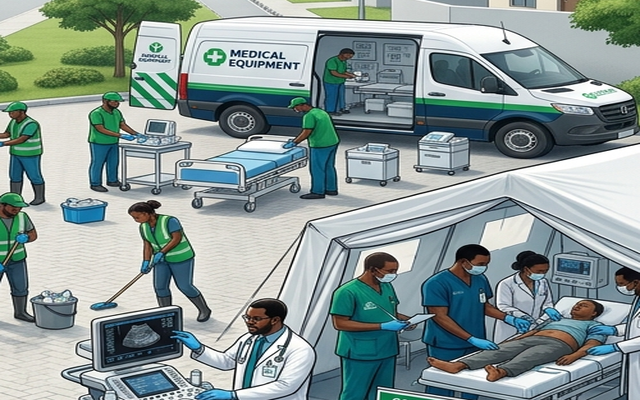
Healthcare facilities across Nigeria rely on sophisticated medical machinery to diagnose and treat patients. Ultrasound scanners, patient monitors, oxygen concentrators, laboratory analyzers, ECG machines, and ventilators are all critical instruments — yet the tropical climate presents severe challenges to their longevity and reliability.
Nigeria's tropical climate is characterized by high ambient temperatures, intense humidity (often exceeding 80% relative humidity in many states), pervasive dust, and chronic power instability. Each of these factors significantly accelerates equipment degradation when not properly managed.
The Threats: Heat, Humidity, Dust, and Power
Heat: Excessive heat causes electronic components to degrade faster. Capacitors, batteries, and circuit boards all have reduced lifespans when operating in high-temperature environments. Cooling systems within devices work harder, consuming more energy and wearing out more quickly.
Humidity: High humidity causes condensation inside equipment housings, leading to internal corrosion, rust on metal contacts, short circuits, and mold growth. Optical components like endoscope lenses and imaging sensors are particularly vulnerable to moisture damage.
Dust: Fine dust particles infiltrate ventilation grilles and fan systems, blocking airflow and causing components to overheat. Dust on optical sensors distorts readings. Particulate contamination in laboratory equipment can compromise test accuracy.
Power Instability: Voltage fluctuations, power surges, and extended outages are common in Nigerian facilities. Without adequate power protection, sensitive electronics can be permanently damaged by a single surge event. Generator switchover also presents risks if not properly managed.
Preventative Maintenance: A Non-Negotiable Investment
The most cost-effective approach to medical equipment management is preventative — not reactive. Without routine preventative maintenance, critical devices can fail unexpectedly, compromising patient care at the worst possible moments.
A robust preventative maintenance program should include:
Daily checks: Visual inspection for physical damage, checking power connections, testing calibration against known standards, and cleaning external surfaces with appropriate non-abrasive materials.
Weekly maintenance: Cleaning of ventilation grilles and fan filters, checking battery levels and backup power systems, inspecting cables and connectors for wear, and reviewing error logs on digital equipment.
Monthly servicing: Internal cleaning using compressed air (in a controlled environment), lubrication of moving parts, calibration verification using reference standards, and software/firmware updates.
Annual overhaul: Comprehensive inspection by certified biomedical engineers, replacement of wear parts, full calibration certification, and performance benchmarking against manufacturer specifications.
Environmental Controls
Beyond equipment-specific maintenance, the facility environment itself must be managed. Equipment rooms and wards housing sensitive devices should maintain air-conditioned environments with stable temperatures (ideally 18–22°C) and controlled humidity levels (40–60% relative humidity).
Uninterruptible Power Supplies (UPS) and voltage stabilizers should be installed on all critical equipment to protect against power fluctuations. Backup generators must be regularly serviced and tested to ensure reliable switchover.
Staff Training
Properly trained clinical and biomedical staff are the first line of defence against equipment failure. Training should cover correct operating procedures, recognizing early warning signs of malfunction, proper cleaning and disinfection protocols, and basic troubleshooting.
Ready to Make a Difference?
Contact Eco-Health today to explore our waste management and recycling solutions for your home, business, or institution.
Get in Touch